How Much Does It Cost to Run a Dryer?
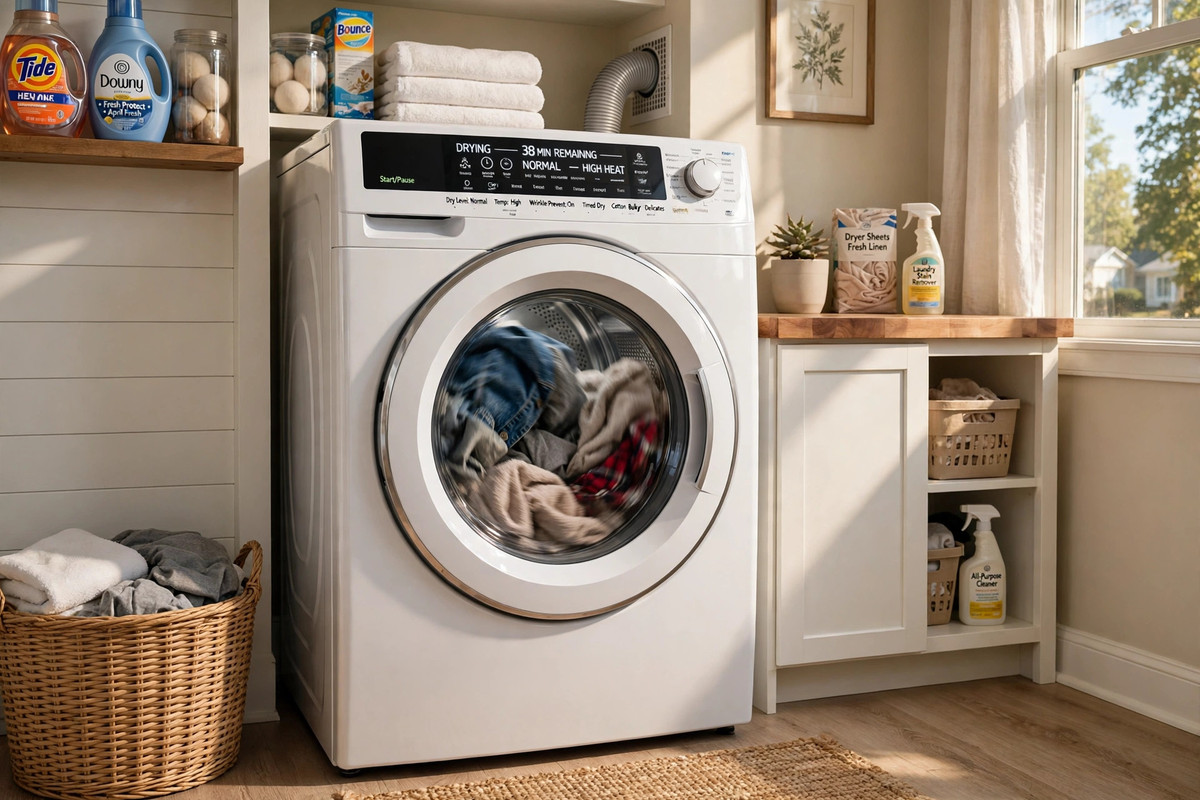
A standard electric dryer costs about $0.41 per load at the U.S. average electricity rate — roughly $8.93 a month if you run five loads a week. In Texas the same load is $0.36; in California it is $0.76. A heat pump dryer cuts the cost roughly in half, to about $0.18 per load.
But the per-load number is not what shows up on your bill. Where the real difference opens up — by dryer type, by state, and by how your utility bills you — is what the rest of this page works through.
How many watts does a dryer use?
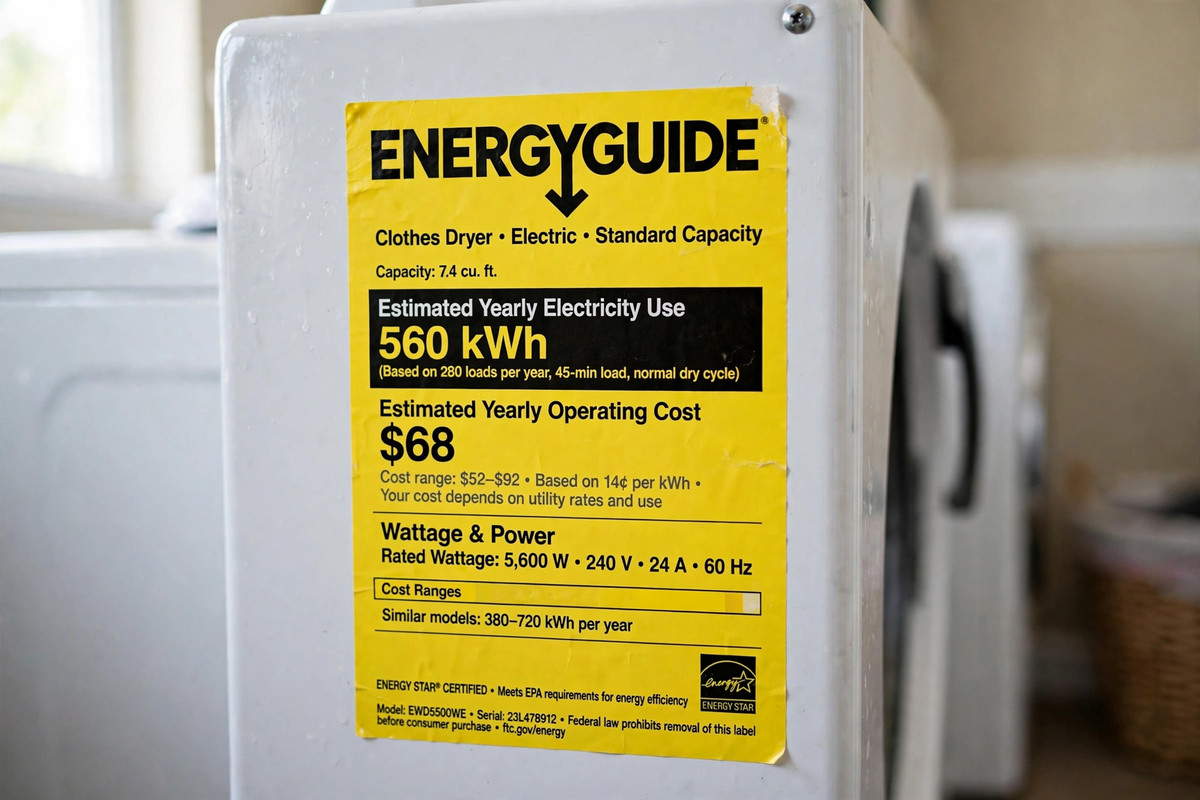
Most full-size vented electric dryers are rated at about 3,000 watts. Depending on the model, the rating runs from roughly 2,000 to 5,000 watts, printed on the label inside the door.
Heat pump dryers are rated far lower, around 800 to 1,200 watts. They do not make heat with a resistance element; they move heat with a compressor, the way a refrigerator works in reverse.
| Dryer type | Rated watts | Energy per load |
|---|---|---|
| Vented electric (standard) | ~3,000 W | ~2.25 kWh |
| Heat pump (ventless) | ~1,000 W | ~1.0 kWh |
One caution before you multiply watts by time: the heating element cycles on and off to hold temperature, so a 3,000-watt dryer does not draw 3,000 watts every minute. That is why the per-load figures above were cross-checked against ENERGY STAR's annual estimates — a certified vented model rated at 608 kWh per year over the DOE's standard 283 test cycles works out to 2.15 kWh per load, close to the 2.25 kWh used here. The most efficient heat pump models, at 266–281 kWh per year, land at about 1.0 kWh per load.
Watts alone, though, do not set your cost. The rate you pay per kilowatt-hour moves the number more than the appliance does — and that is where state lines start to matter.
What does one load cost in your state?
The U.S. Energy Information Administration (EIA) put the average U.S. residential electricity price at 18.31 cents per kWh in July 2026. The spread between states is wide: Texas averaged 15.88 cents, New York 29.90 cents, and California 33.61 cents.
Same dryer, same load, four different prices:
| Rate (EIA, July 2026) | Vented dryer, per load | Heat pump, per load |
|---|---|---|
| Texas — 15.88¢/kWh | $0.36 | $0.16 |
| U.S. average — 18.31¢/kWh | $0.41 | $0.18 |
| New York — 29.90¢/kWh | $0.67 | $0.30 |
| California — 33.61¢/kWh | $0.76 | $0.34 |
In wallet terms: a California household pays more than double per load what a Texas household pays, with the identical machine. If your rate is above 25 cents, the dryer is one of the most expensive appliances you run per hour. If it is under 16 cents, it is a minor line item either way.
Per-load numbers are easy to shrug off, though. Nobody changes a habit over 41 cents. The figure that matters is what accumulates across a month and a year of laundry — that is the next table.
What does a dryer cost per month and per year?
The working assumption here is five loads a week — 21.7 loads a month, 260 a year. That is slightly below the DOE's standard test assumption of 283 cycles a year, so these figures lean conservative.
| Vented electric dryer | Per month | Per year |
|---|---|---|
| Texas (15.88¢) | $7.74 | $92.90 |
| U.S. average (18.31¢) | $8.93 | $107.11 |
| New York (29.90¢) | $14.58 | $174.92 |
| California (33.61¢) | $16.39 | $196.62 |
| Heat pump dryer | Per month | Per year |
|---|---|---|
| Texas (15.88¢) | $3.44 | $41.29 |
| U.S. average (18.31¢) | $3.97 | $47.61 |
| New York (29.90¢) | $6.48 | $77.74 |
| California (33.61¢) | $8.01 | $87.39 |
Read as a bill difference: at the U.S. average rate, a vented dryer adds about $107 a year; a heat pump adds about $48. In California the gap widens to roughly $197 versus $87 — a $109 difference every year, for the life of the machine.
That raises the obvious question: if a heat pump dryer uses half the electricity, why does anyone still buy the vented kind? The answer is not in the cost table. It is in the trade-offs below.
Heat pump vs. vented: which one should you actually buy?
On running cost alone, the heat pump wins everywhere. The annual saving is about $59 at the U.S. average rate, about $51 in Texas, about $97 in New York, and about $109 in California. Over a typical 10-year service life, that is roughly $500 to $1,100 — real money, and in high-rate states it can cover the entire price premium of the machine.
Now the other side. Heat pump dryers usually cost more upfront — commonly a few hundred dollars more than a comparable vented model. They also run longer: a load that takes 45 minutes in a vented dryer can take 60 to 90 minutes or more, because the air never gets as hot. If your household runs back-to-back loads all weekend, that slower cycle is not a footnote; it is your Saturday.
The gentler heat is easier on clothes, and there is no vent to install, which matters in apartments and interior laundry closets. Heat pump models are ventless by design, so they also avoid pushing heated or cooled indoor air out of the house — a hidden cost of vented dryers that never appears in the per-load math.
So the decision sorts itself by two questions. First, your rate: above roughly 25 cents per kWh, the heat pump's savings compound fast enough that it is the default choice unless cycle time is a problem. Below 16 cents, the saving is closer to $50 a year, and a cheaper vented model — or simply keeping the dryer you have — is defensible on the numbers alone.
Second, your laundry pattern. Two or three loads a week will never repay a large price premium quickly, at any rate. Five-plus loads a week in a high-rate state repays it in a few years.
Here is the payback math for a $300 price premium — divide the premium by the annual saving in your state. In Texas, $300 ÷ $51 is about 5.8 years. At the U.S. average, $300 ÷ $59 is about 5 years. In New York it is about 3.1 years, and in California about 2.8 years. If the premium is $500 instead, add roughly two-thirds more time to each figure.
One more type is worth knowing about: hybrid heat pump dryers, which add a conventional heating element to speed up cycles. They use more than a pure heat pump and less than a vented dryer — a middle option if drying time matters more to you than the last few dollars of savings.
The honest answer depends on which household is yours — and one more thing worth checking before either purchase: whether your current dryer is costing more than it should, which is where the limits of these averages come in.
When these numbers don't apply
Gas dryers. These tables are for electric dryers. A gas dryer uses only about 0.2–0.5 kWh of electricity per load for the motor and controls, and burns natural gas for heat — a separate cost on a separate bill, priced per therm.
Older or poorly vented machines. A clogged or crushed vent duct forces longer cycles, and longer cycles are pure extra cost. A 15-year-old dryer running 75 minutes instead of 45 can cost 50% more per load than the figures above.
Time-of-use plans. The rates used here are state averages. If your utility charges different prices by hour, your actual per-load cost depends on when you run the machine — the evening rate can be double the overnight rate on some plans.
Very wet loads. Per-load energy depends heavily on how much water is left in the clothes. A washer with a weak spin cycle hands the dryer extra work; a high-speed spin is effectively a discount on every load.
Compact 120-volt dryers. Small apartment dryers run on ordinary outlets and are rated much lower, often 1,000–1,400 watts, but they dry small loads slowly. Their per-load cost can look low while the cost per pound of laundry is not — the tables here assume full-size 240-volt machines.
How do I calculate the cost for my own dryer?
Three numbers, all findable in five minutes. The formula is: watts ÷ 1,000 × hours per load × your rate = cost per load.
First, find your dryer's wattage on the label inside the door, or in the manual. Second, take your actual cycle time — not the advertised one; time a normal load once. Third, take the per-kWh price from your most recent bill, including delivery charges, not just the supply rate.
Worked example: a 2,800-watt dryer, a 50-minute cycle, and a 22-cent rate. That is 2.8 × 0.83 × $0.22 — about $0.51 per load. Run your own three numbers through it before trusting any national average, including the ones on this page.
Frequently asked questions
How many kWh does a dryer use per load?
About 2.25 kWh for a standard vented electric dryer and about 1.0 kWh for a heat pump dryer, based on nameplate wattage cross-checked against ENERGY STAR annual energy estimates.
How much does it cost to run a dryer for one hour?
A vented dryer draws about 3 kW, so one hour costs roughly $0.55 at the U.S. average rate of 18.31¢/kWh. A heat pump dryer at about 1 kW costs roughly $0.18 per hour.
Is it cheaper to run the dryer at night?
Only if you are on a time-of-use plan with off-peak rates. On a flat-rate plan, the per-load cost is identical at 2 p.m. and 2 a.m. Check your bill: if it lists one price per kWh, timing does not matter; if it lists peak and off-peak prices, it does.
The bottom line
A dryer is a $0.41-per-load appliance at average U.S. rates — but in a high-rate state with a vented machine, it quietly becomes a $197-a-year one, and switching to a heat pump is the single change that cuts that figure in half.
Next in this series: we run the same calculation on the kitchen — Induction vs. Gas: which stove actually costs less to cook on? — where the efficiency gap is bigger than most people expect, and the answer depends on a number printed on your gas bill that few households ever read.
Sources and basis: Electricity rates — U.S. Energy Information Administration (EIA), Electric Power Monthly, residential average prices for July 2026 (U.S. 18.31¢/kWh; Texas 15.88¢; New York 29.90¢; California 33.61¢). Dryer energy use — nameplate wattage (~3,000 W vented, ~1,000 W heat pump) cross-checked against ENERGY STAR certified product data (certified vented example: 608 kWh/yr; most efficient heat pump models: 266–281 kWh/yr, divided by the DOE standard of 283 cycles/yr). Usage assumption: 5 loads per week, 260 loads per year. All dollar figures are calculations from these published values, not measurements of a specific household. Figures checked October 2026.
The images in this post are AI-generated reference images.
댓글
댓글 쓰기